A practical communication assessment tool
that goes beyond interviews and impressions
Japrise
Quantify "speaking ability" with CEFR standards,
for more accurate hiring and talent development.
The "black box" of evaluation happening in today's hiring process
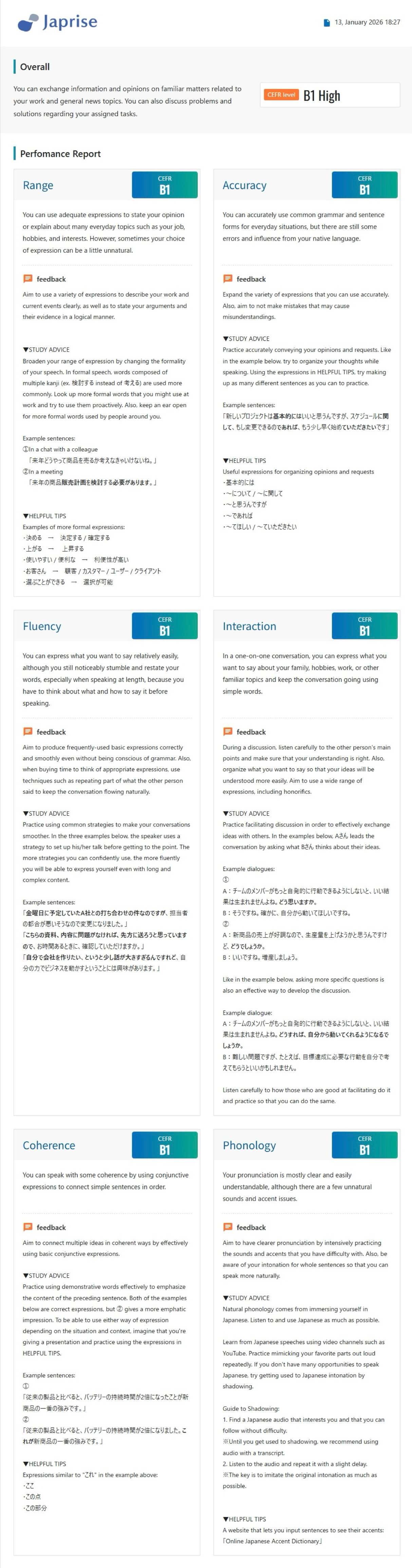
JLPT focuses on grammar and reading — it can't measure speaking ability
Gaps in "listening & speaking" emerge after hiring
Evaluation results vary depending
on the interviewer
An objective, practical indicator
of "speaking ability" is needed.
| Criteria | JLPT | Japrise |
|---|---|---|
| What it measures | Reading & Listening(knowledge-based) | Speaking(practical communication) |
| Rating scale | N5–N1(5-level Japan-specific scale) | CEFR(international standard, A1–C2) |
| Test frequency | Twice a year(fixed schedule) | Available anytime |
| Results turnaround | 2–3 months | Within approx. 10 business days |
Answer 10 questions in a Q&A format.
Evaluated on the relevance of your responses and your ability to elaborate.
Read 8 sentences displayed on screen aloud one by one.
Evaluated on clear, natural Japanese pronunciation.
(※ Kanji are provided with furigana readings)
Give a speech on an assigned topic in your own words.
Your speech must address three pre-specified key points.
Evaluated on relevance and ability to develop your ideas.
Describe a graph or chart shown in the test.
Evaluated on ability to verbally describe non-textual information.
Respond to an automated voice in a set scenario and role.
Evaluated not just on answering, but on understanding the context and responding appropriately.
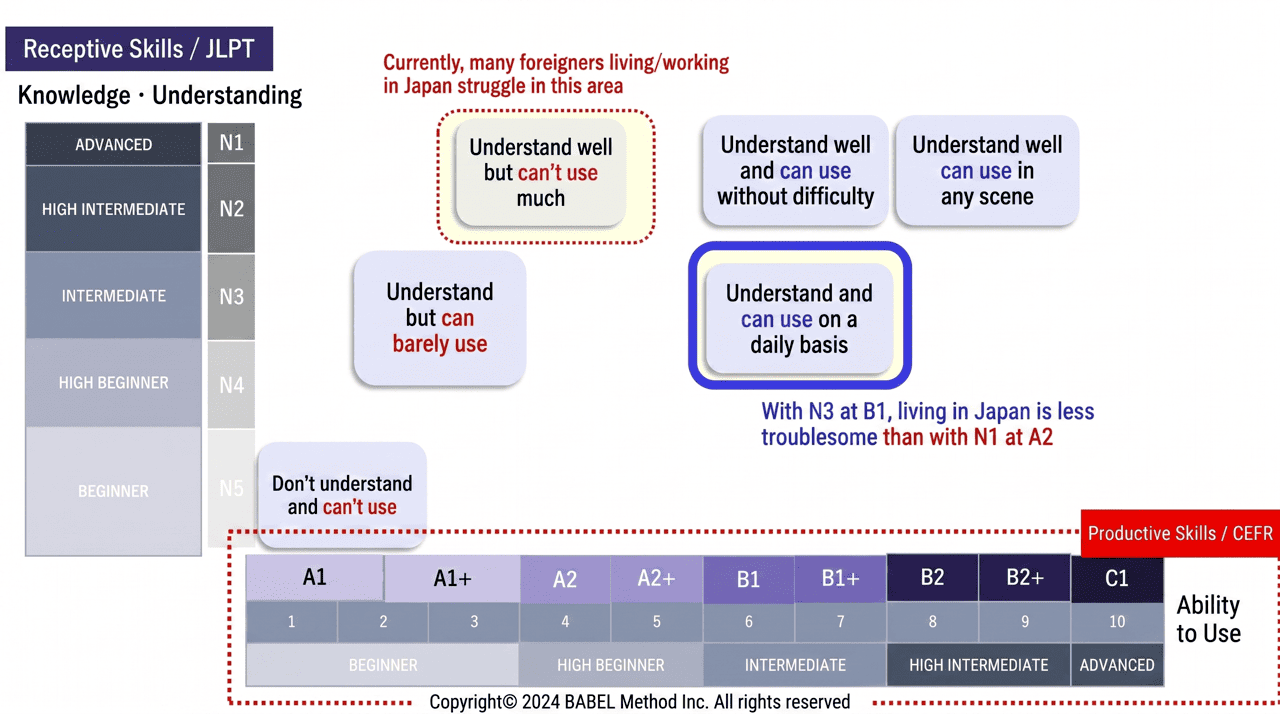
Duration: approx. 20 min / Fully online / Results within 10 business days
※ Sample result report
CEFR (Common European Framework of Reference for Languages) is an international framework developed in Europe to describe language learners' proficiency and communicative competence.
It places particular emphasis on whether a task has been completed and how successfully it was accomplished using the target language.
The chart below illustrates what kinds of workplace communication are possible at each CEFR level from A1 to C2.
※ Created based on the Ministry of Health, Labour and Welfare's "Goal-setting Tool for Japanese Language Proficiency Required in Workplace Situations"
For detailed test specifications and evaluation criteria,
please see the official guidelines.
Just viewed the sample?
Along with case studies from a major airline and companies across other industries, our specialists will propose sample questions and a detailed evaluation report tailored to your target roles and levels.

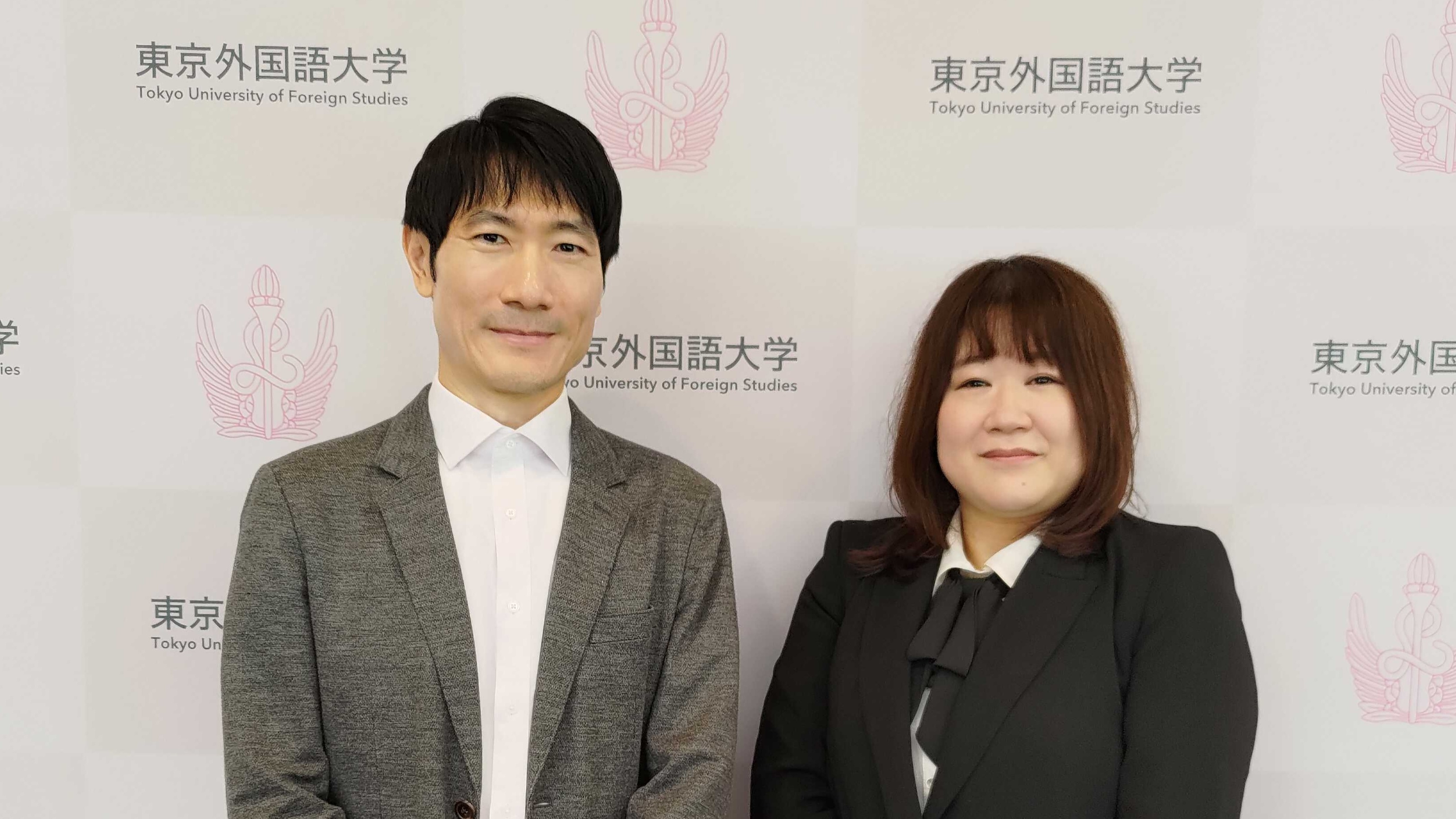

Photo: HIROKI YAMAGUCHI
Tokyo University of Foreign Studies — Special Assistant to the President
Director, World Language Center
Professor, Graduate School of Global Studies
The power of language is its ability to connect people. Sharing feelings and understanding each other is the foundation of building a society where we can live together. Twenty years ago, I encountered the concept of CEFR and was struck by its ability to objectively stage language acquisition, and by how it functions as a framework common to all languages — not just English. Since then, I've continued my research and developed CEFR-J as a Japanese adaptation of CEFR, which has now influenced the English language curriculum guidelines. I feel CEFR is also highly valuable for improving the Japanese language education environment, and I joined the development of Japrise drawing on that philosophy. I hope Japrise will be used as one tool for building a society where we can live together through language.

Tokyo University of Foreign Studies — Director & Professor, Graduate School of Global Japanese Studies
Dean, Faculty of Global Japanese Studies
Drawing on my experience working in a general company and insights from writing assessment research, I focused during Japrise's development on how to measure "the Japanese language behavior required in society." Productive skills like speaking and writing are difficult to evaluate, and assessors' perspectives vary — yet there are common elements. By carefully evaluating those elements, we can concretely identify skills with room to grow and feed that back into learning. By making assessment not an endpoint but a trigger for learning, I hope we can support the process of learners thinking in their own words and using Japanese effectively in society.

Tokyo University of Foreign Studies — Special Assistant to the President (International Education, Social Collaboration, Gender Equality)
Professor, Graduate School of Global Japanese Studies
Director, Next-Generation Japanese Language Education DX Center
Measuring speaking ability at scale has always been constrained by time and personnel, making it difficult to implement broadly in practice. Japrise is meaningful because it can capture conversational ability through natural questions that resemble real interactions. It's also accessible even for learners who struggle with reading and writing — particularly kanji — and can serve as motivation to improve Japanese speaking ability. The ability to assess "the Japanese of interaction" that is difficult to see through written exams is this test's key feature. I hope it becomes a trigger for participants to express themselves in Japanese.
We'll propose the best plan and pricing for your team's size and operations — a demo or a quick question is welcome too.
For consultations, quotes, or demo requests,
please feel free to contact us.